

Deep learning for qMRI parameter estimation
Dr. Gurney-Champion and his team are working on deep learning for improved parameter estimation. Such networks have improved the precision and accuracy of quantitative MRI considerably. Note that this is an ongoing research line and new insights are being tested and integrated over the years. Here, we share the latest networks:
IVIM:
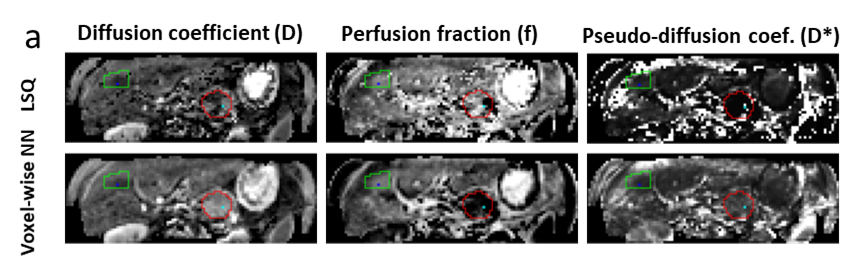
IVIM-NET is a fully-connected deep learning model designed for intravoxel incoherent motion (IVIM) modeling in diffusion-weighted imaging (DWI). This optimized version, known as IVIM-NEToptim , is an improved physics-informed, unsupervised neural network that overcomes the limitations of traditional fitting methods like non-linear least squares and Bayesian approaches (Barbierir et al. MRM 2020, Kaandorp et al. MRM 2021). The network also allows tri-exponential fitting (Troelstra et al. Fron Physiol. 2022).
https://github.com/oliverchampion/IVIMNET
A sequence-independent framework has been implemented by our group (Kuppens et al., MEDIA 2025) and our code is shared at
https://github.com/DKuppens/NCDE-QMRI
DCE:
DCE-NET is a deep learning model designed for parameter estimation in dynamic contrast-enhanced (DCE) MRI (Ottens et al., MEDIA, 2022). This model incorporates physics-informed gated recurrent unit (GRU) with attention layers; long-term-short-memory (LSTM); and U-net networks to estimate physiological parameters based on the extended Tofts model.
https://github.com/oliverchampion/DCENET
Moreover, we have expanded on this to allow aleatoric and epistemic uncertainty estimation (Elburg et al., MEDIA 2026)
https://github.com/JonasElburgUVA/uncertainty-in-quantitative-dce-mri-public
IVIM-DTI:
IVIM-DTI-NET builds upon IVIM-NET but also includes tensor fitting of both the diffusion and pseudo-diffusion part (Voorter et al. MRM 2025).
https://github.com/paulienvoorter/IVIM-DTI-NET
Related publications:
- Van Elburg, J. M., Korobova, N. V., Islam, M. M., Troelstra, M. A., & Gurney-Champion, O. J. (2025). Uncertainty estimates in pharmacokinetic modelling of DCE-MRI. Medical Image Analysis, 103881.
- Kuppens, D., Barbieri, S., Berg, D. V. D., Schouten, P., Thoeny, H. C., Wennen, M., & Gurney-Champion, O. J. (2026). Acquisition-Independent Deep Learning for Quantitative MRI Parameter Estimation using Neural Controlled Differential Equations. Medical Image Analysis, 103768
- Voorter, P. H., Jansen, J. F., van der Thiel, M. M., van Dinther, M., Postma, A. A., van Oostenbrugge, R. J., … & Backes, W. H. (2024). Diffusion‐derived intravoxel‐incoherent motion anisotropy relates to CSF and blood flow. Magnetic Resonance in Medicine.
- Voorter, P. H., Backes, W. H., Gurney‐Champion, O. J., Wong, S. M., Staals, J., van Oostenbrugge, R. J., … & Drenthen, G. S. (2023). Improving microstructural integrity, interstitial fluid, and blood microcirculation images from multi‐b‐value diffusion MRI using physics‐informed neural networks in cerebrovascular disease. Magnetic resonance in medicine, 90(4), 1657-1671.
- Ottens, T., Barbieri, S., Orton, M. R., Klaassen, R., van Laarhoven, H. W., Crezee, H., … & Gurney-Champion, O. J. (2022). Deep learning DCE-MRI parameter estimation: Application in pancreatic cancer. Medical image analysis, 80, 102512.
- Troelstra, M. A., Van Dijk, A. M., Witjes, J. J., Mak, A. L., Zwirs, D., Runge, J. H., … & Gurney-Champion, O. J. (2022). Self-supervised neural network improves tri-exponential intravoxel incoherent motion model fitting compared to least-squares fitting in non-alcoholic fatty liver disease. Frontiers in physiology, 13, 942495.
- Koopman, T., Martens, R., Gurney‐Champion, O. J., Yaqub, M., Lavini, C., de Graaf, P., … & Marcus, J. T. (2021). Repeatability of IVIM biomarkers from diffusion‐weighted MRI in head and neck: Bayesian probability versus neural network. Magnetic resonance in medicine, 85(6), 3394-3402.
- Kaandorp, M. P., Barbieri, S., Klaassen, R., van Laarhoven, H. W., Crezee, H., While, P. T., … & Gurney‐Champion, O. J. (2021). Improved unsupervised physics‐informed deep learning for intravoxel incoherent motion modeling and evaluation in pancreatic cancer patients. Magnetic resonance in medicine, 86(4), 2250-2265.
- Barbieri, S., Gurney‐Champion, O. J., Klaassen, R., & Thoeny, H. C. (2020). Deep learning how to fit an intravoxel incoherent motion model to diffusion‐weighted MRI. Magnetic resonance in medicine, 83(1), 312-321.
Related grants:
- NWO-VIDI: Self-supervised physics-informed deep learning quantitative MRI of tumour microstructural imaging for personalized cancer treatments